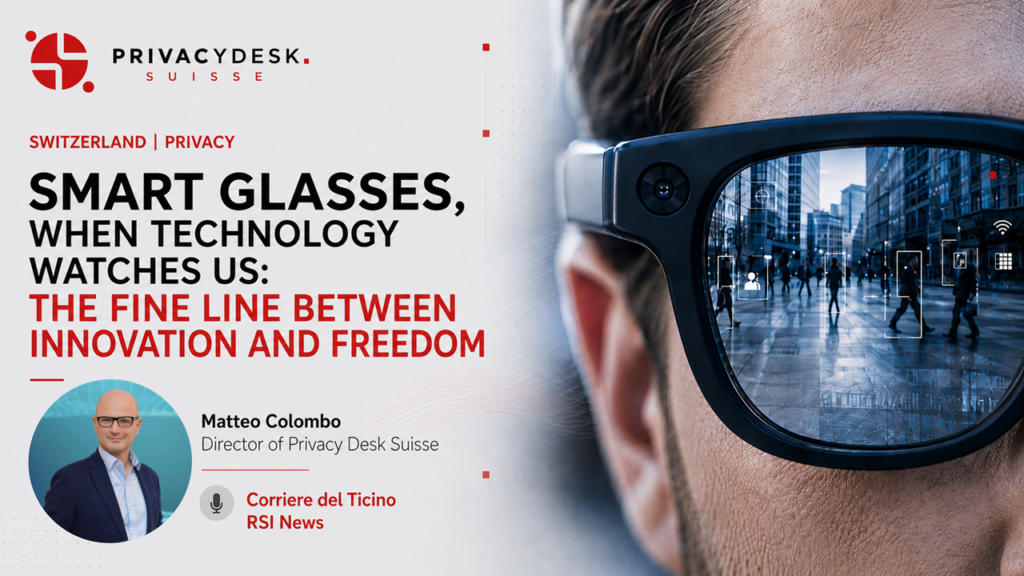
Between the promises of artificial intelligence and growing concerns about privacy, smart glasses are opening a new debate: what happens when what we see can be recorded, analysed, and shared?
Smart glasses are slowly entering everyday life. They look like ordinary frames, but they integrate cameras, microphones, and AI-based features capable of transforming what we see into an enormous amount of data. This technology promises new possibilities but also raises increasingly urgent questions about the right to privacy and control over personal information.
Warning about the potential risks is Matteo Colombo, lecturer at SUPSI and director of Privacy Desk Suisse SA, interviewed by the Corriere del Ticino and the RSI News programme. The central issue of the discussion is not the technology itself, but the way it is used and the fact that those being recorded have often not chosen to be part of this process.
A camera that does not look like a camera
One of the most sensitive aspects of smart glasses concerns their discreet nature. Unlike a smartphone, which is generally recognised as a recording device, a pair of glasses can make it much less obvious when a person is being filmed.
According to Matteo Colombo, this creates a problem of awareness: the person wearing the device makes a choice, while those who enter its field of view often do not. Faces, voices, locations, documents, licence plates, or everyday habits can become data that is collected and potentially analysed.
The risk does not only concern images being published without consent, but also the possibility that large amounts of data may be used to create detailed profiles of individuals. By combining information from images, location data, voice commands, and interactions with artificial intelligence systems, it may become possible to reconstruct highly personal aspects of a person’s life.
The comparison with Orwell: a new form of surveillance?
The reference to George Orwell’s novel 1984 is inevitable when discussing technologies capable of observing and collecting information. However, Matteo Colombo highlights an important difference: in Orwell’s imagined world, surveillance was centralised and imposed by the State, whereas today it can be widespread, fragmented, and entrusted to private individuals and technology companies as well.
The main danger would therefore not be an obvious and declared form of surveillance, but rather a more silent transformation: the so-called “chilling effect”, meaning self-censorship caused by the feeling of being potentially observed.
Knowing that one could be recorded at any moment might lead some people to change their behaviour: avoiding expressing opinions, taking part in certain activities, or visiting particular places. This would represent a limitation of individual freedoms that does not arise from an explicit prohibition, but from the constant perception of being watched.
The challenge for the law: protecting rights without blocking innovation
The spread of smart glasses also raises regulatory questions. Switzerland already has a technologically neutral Data Protection Act, which establishes principles such as transparency, proportionality, and security in the processing of personal information. The challenge will be to determine whether these rules will remain sufficient in the face of tools increasingly integrated with artificial intelligence.
The debate is therefore not about rejecting technology, but about the need to accompany its development with clear rules and greater awareness. Digital tools can offer significant benefits, but they require a balance between innovation and the protection of fundamental rights.
A question that will become increasingly relevant
Smart glasses probably represent only the beginning of a broader transformation: devices that are becoming smaller, more powerful, and increasingly integrated into our daily lives. The key question will be determining where technological convenience ends and where the loss of control over our data begins.
The real challenge will be not only understanding what these tools can do but also deciding which limits we want to establish before they become a normal part of our everyday lives.